Friday, 27 March 2015

Re-thinking our filming location

Initially we filmed our scenes in Bangor behind Bangor abbey, but after three trips that resulted in not enough usable footage, we decided to look elsewhere for a more convenient location to film.

We eventually decided on filming at Shaws Bridge.

These are some photos of our location:


We made arrangement to get to shaw's bridge from Finaghy

It only took us around five minutes to get there which is much more convenient than bangor, which took around 45 minutes by train.

 The terrain of our new location was much more suitable than the last, our location in bangor was mostly flat ground, the new location however is much more uneven and makes it easier to vary shot types and make our scenes much more interesting.


(original filming location)


(new location)


Friday, 20 March 2015

Our Ideas in relation to the Island Magee Witch Trails

We were intrigued by the story of the final witch trails in ireland and decided that we would like to make something based around the struggle of the 8 women arrest.

We have decided to make something that focus' on one woman, who is being persecuted for witch craft.
The woman has received a letter announcing the trail and has to decide whether to run and try to escape her captors or to stay and defend her innocence.

We are also introducing a faceless character who will feature only as someone in the shadows, preparing for the witch hunt against our protagonist, doing things such as preparing weapons and setting fire to torches. This creates the sense of mystery and tension that we need to draw in our audience.

From the feedback we were given from the group that filled in our survey, we have discovered that, to appeal to all audiences, we need to strike a balance between the mystery and action of our antagonist and the drama of our protagonist.

Background to Island Magee Witch Trails

The topic we want to base our film in is the Island Magee Witch Trails, which took place between 1710 and 1711 on Island Magee in which is now known as Northern Ireland. This trial is throughout to be the last witch trial to take place in Northern Ireland.

Some background trials:
It all started when Mrs Haltridge, an Island Magee local, reported phenomenons of poltergeists and potion in the house of Mrs Haltridge. She had been unable to sleep and clothes had been thrown around the house, and a boy appeared to her. She was then heard screaming one night and was found dead, having been stabbed.

Another woman, Mary Dunbar claimed to also being attacked by a woman in her, she named the woman and subsequently 8 women were arrested and put on trail for with craft.

Wednesday, 4 March 2015

Sound in period dramas

After watching a number of period dramas, I have gathered a list of the most commonly used diegetic and non diegetic sounds used in period dramas:


Horses neighing (usually diegetic) example

Horses galloping (both diegetic and nondiegetic) 

People running on gravel paths, footsteps as someone runs (diegetic) example

Birds tweeting in outside shots (nondiegetic) example

Rivers running (diegetic) example

China Clinking (diegetic) example


The sounds that would be of use for our period drama would be the person running on what sounds like gravel, also a sound for the person falling down. in this case I don't really think that the birds tweeting a river noises would necessarily suit the tone of our film as we are trying to create a quite sad and serious tone.

Some examples of period dramas that use the aforementioned sounds would be Pride and Prejudice (2005) Pirates of the Caribbean (2003) and Jane Eyre (any year)

Plot Description

Plot:
Our film is a period drama, or more particularly, a docudrama meaning that we are targeting real events that have happened. We want to tell the story of the Islandmagee witch trials and of the hardships experienced by the eight women who were involved. We want to challenge the treatment of these women by developing emotional drama.
We plan on opening our film with the appropriate indents, followed by some historical information on the witch trials. We need to be careful that our opening to a movie doesn't look like a trailer though.
We will have our protagonist running through the woods, towards some old irish ruins. She is holding a letter, the letter of her conviction. She is clearly distraught and is crying because of her given circumstances. She may never see her family again or worse!
We definitely want to establish an enigma over whether or not the women are guilty and have been practicing witch craft or wether they are totally innocent. In saying this, we also want to open on a powerful note, provoking pathos and sympathy from the audience and therefore, establishing an emotional character/audience link from very early on.

Brief:
We recently attended a cinemagic lecture on pitching a brief and on how to summarise a movie into one sentence, taking the above into consideration, I believe the best way to do this is by the following:
'A tragic tale about the misconceptions of witch craft in Ireland in the early 1700s, coupled with the questionable treatment of females throughout history.'

Timetable


Above are our timetables which are well needed for organisation during the academic year, from the view of a producer or director, organisation is key to success. We have mapped in every possible outcome, from rehersals to editing and we have tried to be as realistic as possible with timing. The next stage is to give my team a copy of this so that they show up on time in order to produce a good final outcome.

Costume

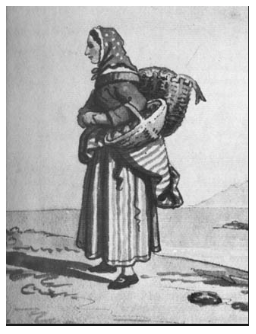
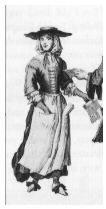
How did working class women dress in the 1700's?
At this time the whole of Ireland was under British rule. The British did not have the ragged poor of Europe. It had not had a peasant class since medieval times and this was reflected in the appearance of its people. You could tell a person’s social class by the clothes that they wore. The richer you were; the better-fitted, brighter-coloured clothes you had. Some servants received clothes as presents. They would have been cast off clothes from a master or mistress, to be worn or sold on. The poorer in society wore second hand clothing.

Clothes tended to be very well looked after. The were patched and darned until they could no longer be repaired and then it was taken apart for a new use. The clothing of the poor is difficult to trace as there are currently no surviving garments and few artists recorded what these people wore. However, some artists had painted lower-class individuals. The only thing to consider is that the artist may lie to flatter or make the painting more aesthetically pleasing. Stitching may not be painted in, colour may have been added and also oils used in the painting may have caused the painting to become worn over time.
Some garments from the 17th century exist today and they would have been expensive or valuable to the people that owned them. Original garments give construction details. The clothes of the working class are expected to have been made in similar manner of cut and tailors would have used less expensive fabric.


Fabrics: Linen was always worn next to the skin. The working class women would more than likely been unable to keep their linen white and would have dressed in cream, grey or beige. Wool and wool mixtures were the typical material for skirts, stays and bodices. Lace was expensive and so although it was made by the poor, it was worn by the rich so we are avoiding using it in our costume.

Colours: Only natural dyes were available but they would have been able to produce a wide range of strong colours. However, the working class would have been limited in the colours that they could buy as they would not have had enough money to by clothes of a variety of colours. The dyes faded more easily then chemical dyes. Washed out muted colurs look better than harsh, strong, bright colours. People     working outdoors and sleeping rough would have caused their clothes to wear faster.
Headgear: Women tended to cover their heads unless they had enough money to have their hair dressed in a fashionable style. Many rich women wore coifs when they did not have time to fix their hair. Covering one’s head was a social convention. No hat and no hairstyle was not seen as indicating an immoral individual however, it did indicate pure laziness.

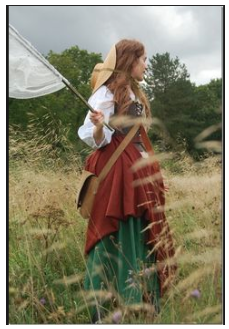
Here is a photo of a young women who is dressed in the typical clothing of a working class women in the 1700's. We can see that she is wearing clothes with noticeable colour however they are still very dull. She is also wearing hat that was typical of working class women at the time. She is carrying a bag over her shoulder that would have been used by the working class women to carry their belongings.